AquariumAquaristik
Banded Leporinus Wild Caught – Leporinus fasciatus M/L 7–9 cm | Striking South American Rarity
Banded Leporinus Wild Caught – Leporinus fasciatus M/L 7–9 cm | Striking South American Rarity
Wieder auf Lager
Couldn't load pickup availability
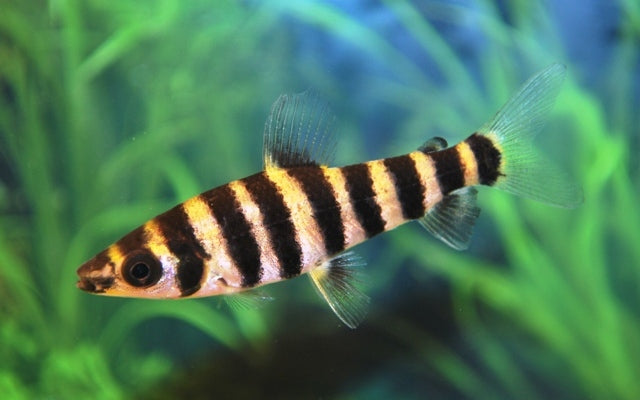
The Banded Leporinus Wild Caught (Leporinus fasciatus) is a striking, powerful fish from South America, immediately noticeable with its distinctive black and yellow striped body pattern. Its high-contrast coloration, torpedo-shaped body, and lively swimming behavior make it a true highlight in large aquariums.
As a wild-caught specimen, Leporinus fasciatus displays particularly intense colors, vitality, and natural behavior. In its native habitat, the middle and lower reaches of the Amazon River, it lives in clear, fast-flowing waters. There, it actively roams its territory and exhibits pronounced social behavior, which can also be well observed in the aquarium.
🌿 Characteristics & Care:
🐠 Size: 7–9 cm (M/L), final size up to approx. 25–30 cm
🌎 Origin: South America (Brazil, Peru, Colombia – wild-caught)
🌡️ Temperature: 24–28 °C
💧 pH value: 6.0–7.5
⚖️ Total hardness: up to 15 °dGH
🐟 Social behavior: Lively, can be dominant within its species – group keeping of 5 or more possible
🌾 Aquarium: From 500 l, with strong current, robust plants, roots, and stones
🍽️ Feeding:
Omnivorous – eats live, frozen, and dry food, but also accepts plant-based food. Vegetable supplements (e.g., spinach, zucchini, algae wafers) are important, as it likes to nibble on plants.
💡 Tip:
Stable décor with sturdy roots and stones is ideal, as the Leporinus enjoys digging and swimming vigorously. Dark substrate and slightly subdued lighting beautifully emphasize its distinctive banding.
👉 Conclusion:
The Banded Leporinus Wild Caught (Leporinus fasciatus) is a striking, active South American rarity with characteristic stripe patterns – ideal for experienced aquarists with large tanks and a preference for distinctive species.
Share